

 By Kaustubh Saini
Python shows up almost everywhere in modern software, from the data team at a bank to the recommendation engine on a streaming service. That range is not an accident. It comes from a specific set of features that make Python pleasant to write and flexible enough for very different jobs. This guide walks through those features one by one, then shows you the real world areas where Python is the go to choice.
Each feature comes with a short example so you can see it, not just read about it. Type them out and run them as you go.
What makes Python special?
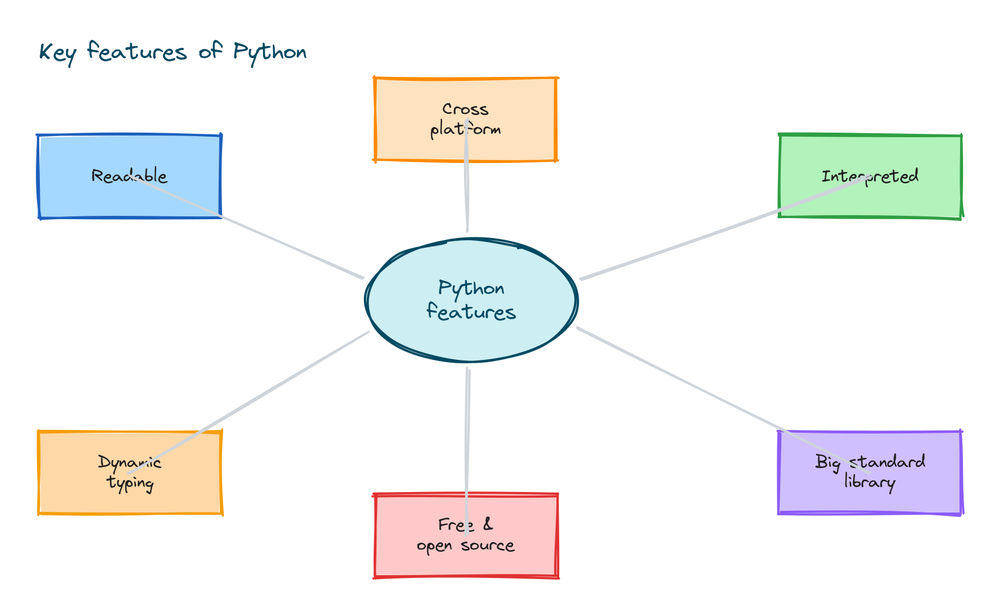
Before the long list, here is the short version. Python is easy to read, runs on every major operating system, comes with a huge library of built in tools, and has one of the largest communities in programming. Those four things together explain why it spread into so many fields. Now let us look at each feature properly.
Easy and readable syntax
Python's biggest feature is also its simplest: the code is easy to read. It uses indentation instead of curly braces and avoids a lot of the punctuation other languages require. The result reads almost like instructions written in English.
numbers = [4, 8, 15, 16, 23, 42]

for number in numbers:
    if number > 20:
        print(number, "is big")
# Output:
# 23 is big
# 42 is big
You can usually guess what a piece of Python does even before you learn the language formally. That readability lowers the barrier for beginners and makes teams faster, because people spend less time decoding each other's code.
Interpreted and interactive
Python is an interpreted language, which means it runs your code directly without a separate compile step. You can also use an interactive shell to test ideas one line at a time and see results instantly.
>>> 2 + 2
4
>>> "hello".upper()
'HELLO'
This quick feedback loop is great for learning, for debugging, and for trying out a library before you commit to it in a full program.
Dynamically typed
You do not declare the type of a variable in Python. You assign a value and Python tracks the type for you. This keeps code short and flexible.
data = 42        # an integer
data = "forty"   # now a string, no error
data = [1, 2, 3] # now a list

print(data)      # Output: [1, 2, 3]
The tradeoff is that some type mistakes only show up when the code runs, which is why many teams add optional type hints on larger projects. For learning and most scripts, dynamic typing is a real convenience.
Cross platform and portable
Python runs on Windows, macOS, and Linux. A script you write on one usually runs on the others without changes, because Python sits on top of the operating system and handles the differences for you.
import platform
print("Running on:", platform.system())
# Output on a Mac:    Running on: Darwin
# Output on Windows:  Running on: Windows
A huge standard library
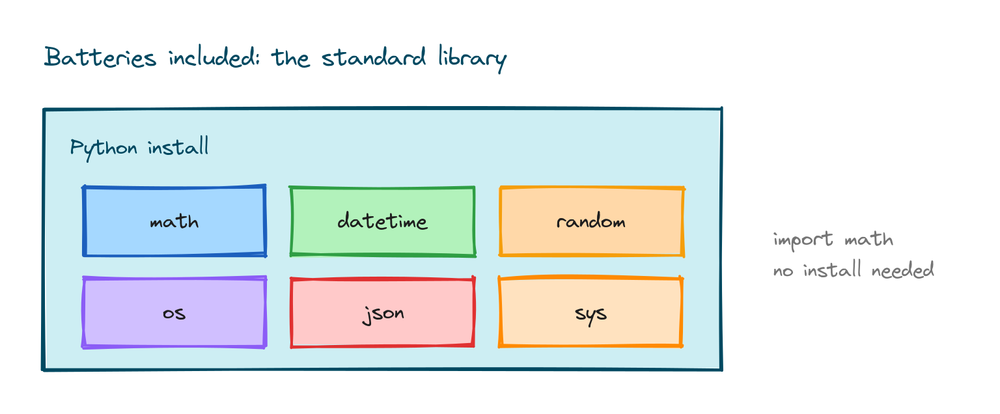
People say Python comes with "batteries included" because the standard library already handles so many common tasks: dates, math, files, randomness, web requests, and more. You import a module and it just works, no install needed.
import datetime
import random

print(datetime.date.today())   # Output: today's date, e.g. 2026-06-27
print(random.choice(["a", "b", "c"]))  # Output: a random pick
Supports many programming styles
Python does not force one way of writing code. You can write simple top to bottom scripts, group code into functions, or use full object oriented programming with classes. It even supports functional touches like map and lambda functions.
# object oriented style
class Circle:
    def __init__(self, r):
        self.r = r
    def area(self):
        return 3.14159 * self.r * self.r

print(Circle(5).area())   # Output: 78.53975
Free, open source, and well supported
Python is free to download and use, and its source code is open for anyone to read. It is backed by a large, active community, which means most problems you hit already have answers online, and there is a library for almost anything you can think of. That ecosystem is one of Python's strongest advantages over newer languages.
Where Python is used in the real world
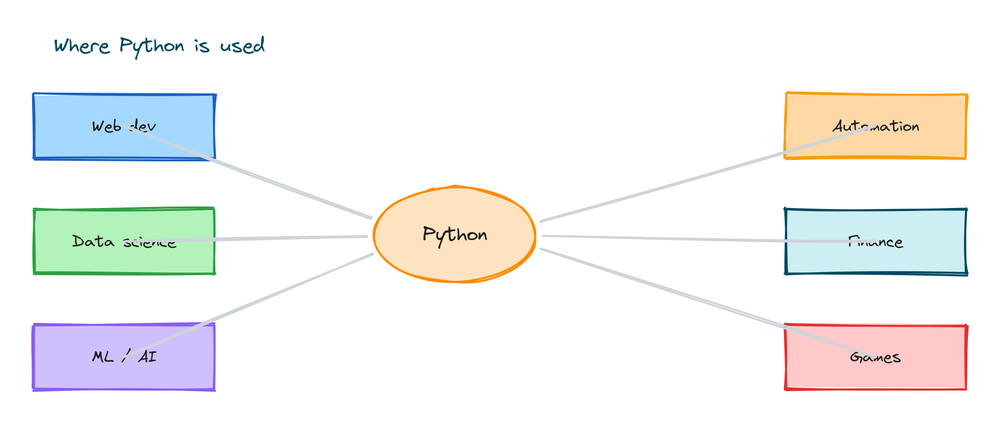
Those features add up to a language that fits an unusually wide range of jobs. Here are the biggest areas, with what Python brings to each.
Web development
Frameworks like Django and Flask let you build full websites and web APIs in Python. Django handles big, database heavy sites, while Flask is lighter and great for smaller services. Many well known web products run Python on the backend.
Data science and analysis
This is one of Python's strongest areas. Libraries like pandas, NumPy, and matplotlib let analysts clean data, run calculations, and draw charts with very little code.
import statistics
scores = [78, 91, 85, 67, 90]
print("Average:", statistics.mean(scores))
# Output: Average: 82.2
Machine learning and AI
Most modern machine learning happens in Python. Libraries such as scikit-learn, TensorFlow, and PyTorch make it the default language for training models, and a lot of cutting edge AI research ships its code in Python first.
Automation and scripting
Python is perfect for the small jobs that save you time: renaming hundreds of files, sending scheduled emails, scraping a website, or moving data between systems. A short script can replace an hour of manual clicking.
import os
files = os.listdir(".")
print("This folder has", len(files), "items")
# Output: This folder has 12 items
Scientific and numeric computing
Researchers in physics, biology, and engineering use Python with libraries like SciPy and NumPy to run simulations and analyze experiments. It has largely become the language of academic computing.
Desktop apps and games
With tools like Tkinter you can build simple desktop applications, and with Pygame you can make 2D games. These are not Python's most famous uses, but they are great for learning and for small projects.
Finance and fintech
Banks and trading firms use Python for data analysis, risk models, and automation. Its mix of readability and strong number libraries fits financial work at any scale, powering everything from institutional trading algorithms to the backend of online invoicing software for small businesses.
Are there any downsides?
To keep this honest, Python is not perfect for everything. It is slower than compiled languages like C++ for raw number crunching, and it is not the usual choice for mobile apps. For performance critical pieces, teams sometimes write the hot part in another language and call it from Python. For the huge majority of projects, though, Python's speed is more than enough, and developer time usually matters more than a few milliseconds.
Practice exercises
These short tasks let you feel a few of Python's features in action rather than just reading about them.
Exercise 1: Use the standard library
Import the math module and print the square root of 144, showing off the "batteries included" feature.
# Solution
import math
print(math.sqrt(144))    # Output: 12.0
Exercise 2: Dynamic typing in action
Assign a number to a variable, print it, then assign text to the same variable and print again.
# Solution
value = 100
print(value)      # Output: 100
value = "done"
print(value)      # Output: done
Exercise 3: A readable loop
Loop over the list ["data", "web", "ai"] and print each application area in a sentence.
# Solution
for area in ["data", "web", "ai"]:
    print("Python is great for", area)
# Output:
# Python is great for data
# Python is great for web
# Python is great for ai
Common misconceptions
- "Python is only for beginners." Not true. Large companies run major production systems in Python. It scales from your first script to serious software.
- "Python is too slow to be useful." It is slower than compiled languages for heavy math, but for most web, data, and automation work it is fast enough, and heavy libraries are written in fast C under the hood.
- "You need to install a lot before you can do anything." The standard library already covers many tasks, so a fresh install can do a great deal with no extra packages.
- "Python is just for data science." Data science is popular, but Python is general purpose and is used for web apps, automation, finance, and more.
Frequently asked questions
What are the main features of Python?
Readable syntax, interpreted execution, dynamic typing, cross platform support, a large standard library, support for multiple programming styles, and being free and open source. Together these make it flexible and beginner friendly.
What is Python mostly used for?
Its biggest areas are data science, machine learning, web development, and automation. Because it is general purpose, it also appears in finance, scientific computing, desktop apps, and games.
Why is Python so popular?
It is easy to learn, works for many different tasks, has a huge library ecosystem, and has one of the largest communities in programming, so help and tools are always available.
Is Python good for web development?
Yes. Django and Flask are mature, widely used frameworks for building websites and APIs in Python, suitable for both large and small projects.
What is the main weakness of Python?
Speed. Python is slower than compiled languages for heavy number crunching, and it is rarely used for mobile apps. For most projects this is not a problem.
Key takeaways
- Python's core features are readable syntax, interpreted execution, dynamic typing, cross platform support, and a large standard library.
- It supports scripting, functional, and object oriented styles, so it adapts to many problems.
- Being free, open source, and community backed gives it a huge ecosystem of libraries.
- Its top applications are data science, machine learning, web development, and automation.
- Its main downside is raw speed, which rarely matters for everyday projects.
If you are deciding whether Python is worth learning, its mix of easy syntax and wide reach is the answer. Pick an area that excites you, whether that is data, the web, or automation, and start building something small in it.