

 By Kaustubh Saini
Python is everywhere today, but it did not start as a big project at a famous company. It began as one programmer's holiday hobby in 1989. Knowing where Python came from helps you understand why it looks and feels the way it does, and why some quirks (like the Python 2 versus Python 3 split) exist at all. This is the short, friendly history of the language, from a Christmas side project to one of the most used languages in the world.
Who invented Python?
Python was created by Guido van Rossum, a Dutch programmer. In December 1989 he was looking for a project to keep himself busy over the Christmas holidays, and he decided to build an interpreter for a new scripting language he had been thinking about. That holiday project became Python.
Van Rossum wanted a language that was powerful like the ones he used at work, but far easier and more pleasant to read. That goal, readability and simplicity, has shaped every version of Python since.
Where does the name come from?
Here is the fact that surprises almost everyone: Python is not named after the snake. Van Rossum was a fan of the British comedy group Monty Python, and he wanted a name that was short, unique, and a little bit playful. The snake imagery came later, mostly because it makes for good logos and book covers.
The first release
Python's first public release, version 0.9.0, came out in February 1991. Even in that early version, many ideas that still define Python were already present: functions, exception handling for errors, and core data types like lists and dictionaries.
# Ideas from the very first releases that you still use today
fruits = ["apple", "banana"]   # lists existed early
person = {"name": "Guido"}      # so did dictionaries

print(fruits)    # Output: ['apple', 'banana']
print(person)    # Output: {'name': 'Guido'}
Python 1.0 followed in 1994, adding tools like map and filter that are still part of the language.
Python 2: growing up
Python 2.0 arrived in 2000 and was a big step forward. It introduced list comprehensions, a clean and popular way to build lists, and better support for Unicode text. It also brought a garbage collector that could handle tricky memory situations.
# List comprehension, introduced in Python 2.0 and still loved today
squares = [n * n for n in range(5)]
print(squares)   # Output: [0, 1, 4, 9, 16]
Python 2 became hugely popular, and for years it was simply "Python" to most people. Its final major release, Python 2.7, hung around for a very long time.
Python 3 and the big split
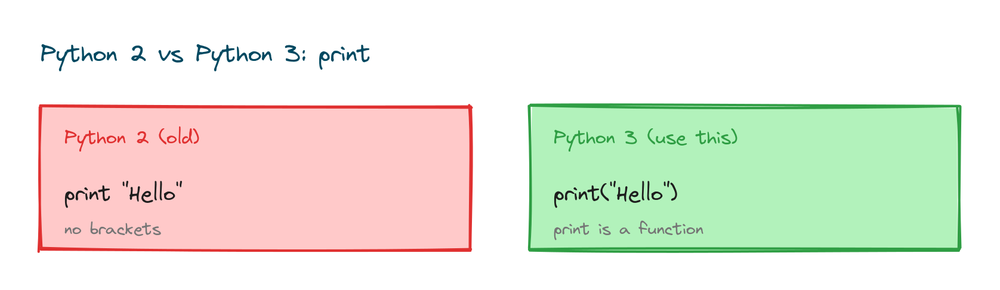
Python 3.0 was released in 2008, and it was a deliberate clean break. The team fixed several old design decisions that could not be changed without breaking existing code. The most famous change: in Python 3, print became a function with parentheses.
# Python 2 style (no longer valid in Python 3)
# print "Hello"

# Python 3 style
print("Hello")
# Output: Hello
Because Python 3 was not fully backward compatible, the community split for years. Some projects moved quickly, others stayed on Python 2 because their libraries had not been updated. This long transition is the reason you still see old tutorials written in Python 2 style.
The end of Python 2
The split finally closed on January 1, 2020, when Python 2.7 officially reached its end of life. After that date it stopped receiving any updates, including security fixes. Today, Python 2 is history. All new code should be written in Python 3, and every modern tutorial, including ours, uses it.
The Zen of Python
In 2004, a longtime contributor named Tim Peters wrote down the guiding philosophy of the language as a short set of sayings called the Zen of Python. It is built right into the language as an Easter egg. Try it yourself:
import this
# Output (first lines):
# Beautiful is better than ugly.
# Explicit is better than implicit.
# Simple is better than complex.
These lines are not just cute. They explain why Python favors readable, straightforward code over clever tricks, and they still guide how the language evolves.
From one leader to a council
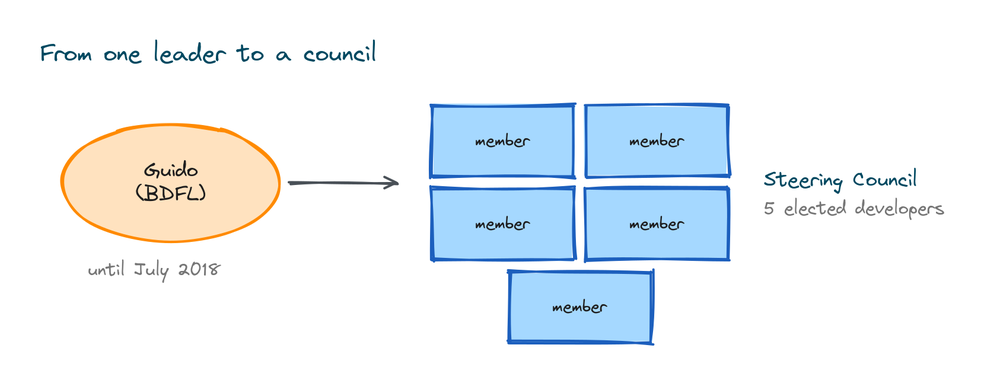
For most of Python's life, Guido van Rossum made the final call on major decisions. The community gave him the playful title BDFL, short for Benevolent Dictator for Life. He guided the language for nearly three decades.
In July 2018, after a heated debate over a language feature, van Rossum stepped down from that role. Rather than hand power to one new person, the community created a Python Steering Council, a group of five experienced developers elected by the core team. They have guided Python ever since, and elections are held regularly. Python's direction is now a shared, community run effort.
Python today
Python keeps improving on a steady yearly schedule, with a new major version each October. The current version is Python 3.14, released in October 2025, with point releases like 3.14.6 arriving through 2026 to fix bugs. Recent versions have focused heavily on making Python faster and on better error messages, which is great news for beginners who rely on those messages to learn.
python --version
# Output: Python 3.14.6
From a one person holiday project to a language steered by an elected council and used around the world, Python's history is really a story about a simple idea, readable code, paying off over and over.
A short timeline
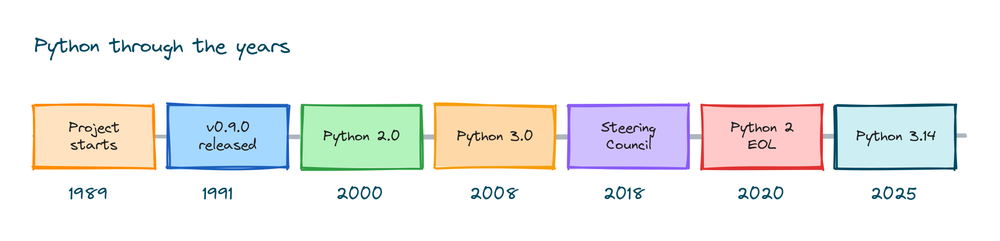
- 1989: Guido van Rossum starts Python as a holiday project.
- 1991: Python 0.9.0, the first public release.
- 1994: Python 1.0.
- 2000: Python 2.0, with list comprehensions.
- 2008: Python 3.0, a clean break for the future.
- 2018: Van Rossum steps down as BDFL; the Steering Council is formed.
- 2020: Python 2.7 reaches end of life.
- 2025: Python 3.14 released, the current major version.
Practice exercises
History is more fun when you poke at the language itself. Try these, then check your answers.
Exercise 1: Read the Zen of Python
Run the hidden Easter egg that prints Python's guiding philosophy, written in 2004.
# Solution
import this
# Output (first line): Beautiful is better than ugly.
Exercise 2: Check your version
Print the exact Python version your computer is running using the sys module.
# Solution
import sys
print(sys.version)
# Output: 3.14.6 (plus build details)
Exercise 3: Quick history quiz
Answer these from memory, then check below. (a) Who created Python? (b) What is the name from? (c) When did Python 2 reach end of life?
# Answers
# a) Guido van Rossum
# b) The comedy group Monty Python, not the snake
# c) January 1, 2020
Common misconceptions about Python's history
- "Python is named after the snake." It is named after Monty Python, the comedy group. The snake came later, mostly for logos.
- "Python 3 is a small update over Python 2." It was a deliberate clean break that was not fully backward compatible, which is why the transition took years.
- "Python 2 is still fine to use." Python 2.7 reached end of life in 2020 and gets no more updates, including security fixes. Use Python 3.
- "Guido van Rossum still controls Python alone." He stepped down as BDFL in 2018. An elected Steering Council now guides the language.
Frequently asked questions
Who created Python and when?
Guido van Rossum, a Dutch programmer, created Python. He began work on it in December 1989 and released the first version, 0.9.0, in February 1991.
Why is it called Python?
It is named after the comedy group Monty Python, not the snake. Guido van Rossum wanted a short, memorable, slightly playful name.
What is the difference between Python 2 and Python 3?
Python 3, released in 2008, was a clean break that fixed old design issues and was not fully backward compatible. For example, print became a function. Python 2 reached end of life in 2020, so all new code uses Python 3.
Is Python 2 still used?
It should not be for new projects. Python 2.7 reached its end of life on January 1, 2020, and no longer gets security updates. Some old systems still run it, but the standard everywhere now is Python 3.
Who controls Python now?
A Python Steering Council of five elected developers, formed in 2018 after Guido van Rossum stepped down as Benevolent Dictator for Life. The council guides the language's direction, and elections are held regularly.
Key takeaways
- Python was created by Guido van Rossum, starting as a 1989 holiday project, with its first release in 1991.
- The name comes from Monty Python, not the snake.
- Python 2 (2000) was hugely popular; Python 3 (2008) was a clean break that caused a long transition.
- Python 2.7 reached end of life in 2020, so all new code uses Python 3.
- Since 2018, an elected Steering Council guides the language instead of a single leader.
- The current version is Python 3.14, with readability and speed still driving its development.
Now that you know the backstory, the modern language will make more sense. The next step is to install the current version and start writing Python 3, the only version you need today.