AI Interview Cheating Has Employers Asking Candidates to Wave at the Camera

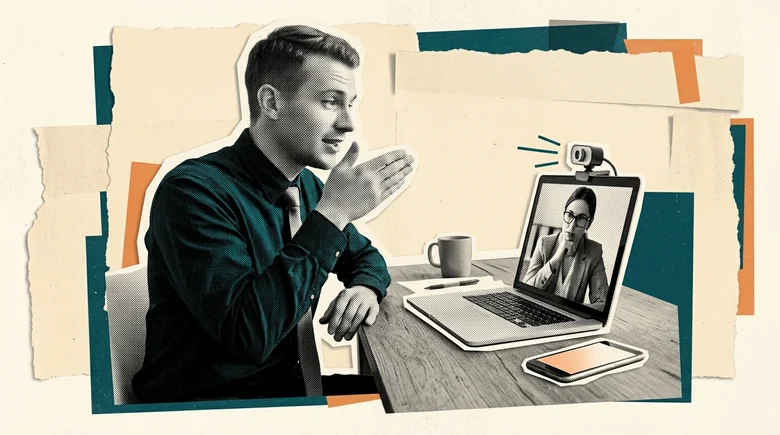
Some job candidates are now asked to wave a hand in front of their face before the interview can carry on.
The request sounds odd until you know what it catches. An AI-generated face on a video call usually cannot survive a hand passing over it. The fake smears or slips for a moment, and a real face does not.
The Wall Street Journal reported on 1 September that remote employers have started running checks like this as a matter of course. Candidates are asked to drop their virtual backgrounds, pan the camera around the room and share their screens. The point is to prove that one human is in the room, and that nobody is feeding them answers.
Somos Asks Candidates to Wave a Hand in Front of Their Face
The new checks are cheap physical tests, and they are aimed at faces.
Somos, a remote-first telecommunications and security company, asks candidates to show their surroundings and wave a hand in front of their face. The company also checks IP addresses. It started doing that after it found candidates who said they were in the United States and were somewhere else.
Heather Wilcox, a quality engineer who is job hunting now, told the Journal she has been interviewed by AI software that tracks her eye movements. The software watches for the reading pattern of someone working off a hidden script.
Some candidates have ended interviews when asked to do any of this.
Two different problems are getting the same answer here, and that is worth pulling apart. One problem is a person who is not who they say they are. The other is a real person with a real name who has a chatbot open on a second screen. A hand wave catches the first. It does very little about the second, because the candidate's face is genuinely their own.
35% of Managers Say Someone Else Showed Up on Camera
The number that justifies a hand wave comes from Checkr, which surveyed 3,000 US managers who had hired in the previous year.
Of those managers, 35% say someone other than the listed applicant has taken part in a virtual interview. Another 31% say they have interviewed a candidate who turned out to be using a fake identity. So this is not a worry about what might happen. Roughly one manager in three has already watched it happen.
The confidence numbers are the uncomfortable part. Only 19% said they were extremely confident that their hiring process would catch a fraudulent applicant. And 62% agreed that job seekers are now better at faking identities with AI than hiring teams are at spotting them.
That gap explains the camera tricks. When you do not trust your process, you reach for a test you can watch with your own eyes.
The 59% Everyone Is Quoting Is a Year Old
Almost every story about this cites one figure: 59% of managers have suspected a candidate of using AI to misrepresent themselves. It is a real number from the same Checkr survey.
It is also from September 2025. Checkr published it on 16 September that year, written up by David Patterson, the company's director of communications. A year later it is still being quoted in September 2026 coverage with no date attached.
We are not saying the figure is wrong. We are saying nobody has a current one. Treat 59% as a floor from a year ago and not as a reading of the market you are interviewing in today. If you see it quoted as a 2026 statistic, the writer did not check.
Google and McKinsey Moved Rounds Back Into a Room
The bigger shift is happening in office buildings, away from the webcam entirely.
A Gartner survey found 72.4% of recruiting leaders now run interviews in person to fight fraud. Google, McKinsey, Cisco and Deloitte have all brought back at least one in-person round. McKinsey asks hiring managers to schedule a face to face meeting, and Google requires one in-person round for potential hires.
Smaller companies are going further. At Nominal, final interviews happen in person and candidates take coding tests on company laptops, so the firm controls the machine. Co-founder Bryce Strauss put the reasoning plainly.
"The way to stand out in this moment is to be fundamentally human."
Bryce Strauss, co-founder of Nominal, to The Wall Street Journal
Passion.io, a remote-first startup, moved away from some take-home assignments after finding that candidates were sending back heavily AI-generated work. It now leans on screen sharing and live written exercises. BrightHire, which sells software for remote interviews, watches signals like browser tab switching, and a person reviews the result before anything is decided.
Nobody has said out loud what this costs. An in-person final round means travel, time off and a day of unpaid effort. Candidates who live near a hub can absorb that. Candidates who do not are paying for a problem other people created.
The Tools They Are Watching For Cost About $100 a Month
The software behind all of this is not exotic. A live interview copilot listens to the call, transcribes the question and puts a suggested answer on a hidden overlay. Cluely, Interview Coder and Parakeet AI are the names that come up most.
The hiring platform Fabric analysed 19,368 of its own first-round interviews. It flagged 38.5% of candidates for AI-assisted behaviour, and priced a dedicated interview assistant at $50 to $150 a month. Its detection list names Cluely and Parakeet AI by name. Being on a detection vendor's list is a strange kind of fame for a product that advertises itself as undetectable.
Read that 38.5% with some care, because Fabric sells the detection that produced it. A vendor measuring the problem it is paid to solve is worth quoting and worth discounting at the same time. The recruitment trainer SocialTalent made a sharper version of that point in August, noting that 61% of the candidates Fabric flagged still cleared its own pass mark. Detection caught them and the interview passed them anyway.
Our own testing of Parakeet AI found the invisibility claim does not hold. A reviewer reported on 17 September that proctoring software flagged their screen share. The company's own board of verified platform checks had not been re-run for 29 days when we looked.
There is a quieter tell the camera tricks will never catch. These tools write answers that are better than the person delivering them. A candidate who produces a polished solution and then cannot defend it under a follow-up question has not been caught by software. They have been caught by an interviewer who kept asking.
A Quarter of Managers Say Their Own Company Posted Fake Jobs
Buried in the same Checkr survey is a finding that did not travel, and it should have.
26% of managers believe their own company has posted fake job listings at some point. The reasons given were gauging market interest, projecting growth, or building a pipeline for later. None of those involve a job that exists.
Hold the two numbers next to each other. A quarter of managers think their employer has advertised roles that were not real. Those same managers are now asking candidates to prove they are real by waving at a webcam.
The suspicion runs both ways, and only one side is being asked to perform. A candidate cannot ask a company to pan its camera around and show them the open headcount.
Walking Out of the Check Is the Worst Move You Can Make
Some candidates have ended interviews when asked to show the room. That reaction is understandable and it is also the most expensive thing you can do, because the interviewer has no way to read it except one way.
So here is the practical version, if one of these lands on you.
Do the check, and do it without making it a thing. Panning a camera and waving a hand costs you 10 seconds and settles the question. If you are asked why, say you would rather get it out of the way, and carry on.
Know which requests are ordinary and which are not. Checkr found 55% of employers use live video interviews and 58% run government ID checks, so those are now routine. Biometric or facial verification is used by 25%, and that one stores something about your body. You are allowed to ask what happens to it and how long it is kept.
Ask about AI before the round starts, not after. The recruiter Mike Hauschild said some companies actively encourage AI on take-homes and coding exercises while expecting your own thinking elsewhere. Those rules are now different at every employer, and nobody will volunteer them.
The honest reading of all this is uncomfortable. The checks exist because enough people cheated to make trust expensive, and the cost has landed on everybody who did not. An employer running a hand wave test is not accusing you of anything. It has simply stopped being able to tell, and it is charging every candidate 10 seconds of proof to cover the few it cannot catch. That is the bill for the last two years, and job seekers are the ones paying it.