OpenAI Launches ChatGPT for Teens 'to Promote Healthy Use'

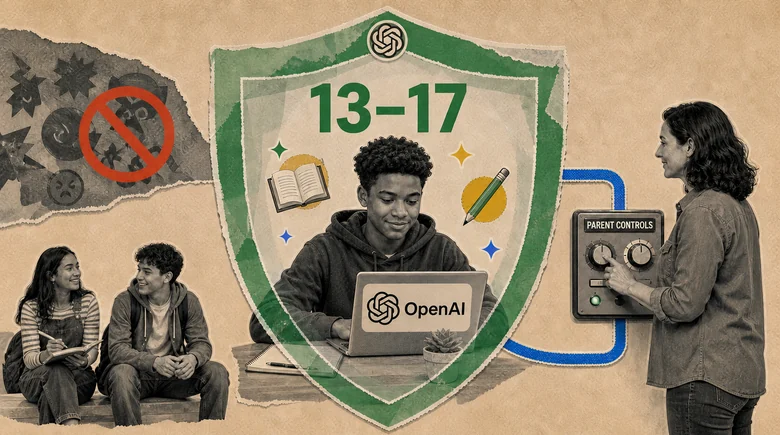
OpenAI just released a new version of ChatGPT designed specifically for teenagers. This version comes packed with safety guardrails that parents and teens should know about.
ChatGPT for Teens is Designed for Younger Users
OpenAI officially released ChatGPT for Teens, a version for younger users. Your ChatGPT account will automatically switch to the 'Teens' version when the system estimates someone is under 19 or they state their age is between 13 and 17.
Since OpenAI does not verify user ages through official identification, the company uses an age prediction model to estimate whether someone is under 18 based on their chat behavior and query patterns.
When OpenAI identifies a user as a minor, the system automatically switches them to ChatGPT for Teens.
This approach balances ease of access with safety. Users do not need identification to sign up, keeping the process simple. At the same time, OpenAI's detection system catches most minors and moves them to the protected version of the app.
Protections are based on the Under-18 Principles in the Model Spec. It covers self-harm, violence, dangerous activities, explicit graphic content, and even eating disorders.
Even it adds caution during sensitive-image upload reminders, alerting teens when they are about to share private or sensitive images.
OpenAI faced immense pressure from regulators and parents about AI safety for minors. So, creating a dedicated teen version shows OpenAI is taking these concerns seriously.
Ann O'Leary, the vice-president of global policy at OpenAI, said:
"We want to treat teens like teens, which means that we have to make sure that we're showing up with the right developmental stage when we're not either talking down to them or treating them like kids, but we're also making sure that they're not exposed to material that they shouldn't be exposed to."
Ann O'Leary, vice-president of global policy at OpenAI
OpenAI is rolling out ChatGPT for Teens globally from August 18 to all free and paid personal accounts.
More Parental Controls
Both the teen and their parent or guardian must agree to activate parental controls. The feature does not turn on automatically. Each person has to opt in separately.
Parents with linked accounts can set quiet hours, manage selected settings, and get safety notifications.
- Parents can set 'Quiet Hours' when teens can't access their ChatGPT accounts.
- They can set 'Study Hours' when new chats automatically start in study mode.
- They can also receive safety notifications in limited high-risk situations, including eating disorders.
OpenAI also updated the Model Spec today with clearer principles on relational interactions for teens. ChatGPT should not use romantic language, encourage emotional dependence, or imply it has feelings or consciousness.
But parental controls do not let a parent read the teen's conversations.
Use It for School Work
ChatGPT for Teens bundles teen onboarding, Study Mode, quizzes, learning visualizations, and responsible homework reminders.
Study Mode is switched on by default. Instead of just giving you an answer, this mode questions you, guides your thinking, explains ideas step by step, and checks your understanding along the way.
You can use study mode to learn new concepts, work through homework step by step, prepare for quizzes and tests, review class notes or slides, create practice questions, or understand why answers are correct or incorrect.
It also lets you upload course materials like class notes, syllabuses, worksheets, slides, textbook excerpts, or photos of problems. ChatGPT references these materials while helping you study.
There are Homework reminders too. ChatGPT can now recognize when teens might be rushing through assignments and guide them toward Study Mode instead.
CodeAI to Teach AI Literacy
OpenAI and CodeAI announced a partnership focused on helping students understand AI beyond just using it. The collaboration gives students and educators access to tools and resources that help them learn how to use AI effectively and responsibly.
Both companies want teens to understand how AI actually works so they can direct it intelligently, question its outputs with confidence, and create new things with it.
This broader focus on AI literacy can extend beyond the classroom as learners develop practical skills for working with different AI tools. Platforms such as Coursiv provide guided learning designed to help users build confidence with AI and apply these tools to practical, everyday tasks.
Teachers are central to this partnership. Rather than letting AI simply enter classrooms without guidance, the collaboration ensures educators play a meaningful role in deciding how AI gets used and taught.
Takeaways
ChatGPT for Teens addresses a real concern: 72% of American teens already use AI chatbots for companionship, with half engaging regularly, according to Common Sense Media research.
OpenAI is responding by creating a supervised version with parental oversight and safety guardrails. This approach may become standard as more AI companies target younger users.