OpenAI's Revenue Run Rate Tops $40 Billion, Double Its Late 2025 Pace
OpenAI is now on pace to make more than $40 billion a year, about double where it stood at the end of 2025. The number rests on one very strong July, and it reached Bloomberg on the same day the company replaced its head of sales for the second time in under a year.

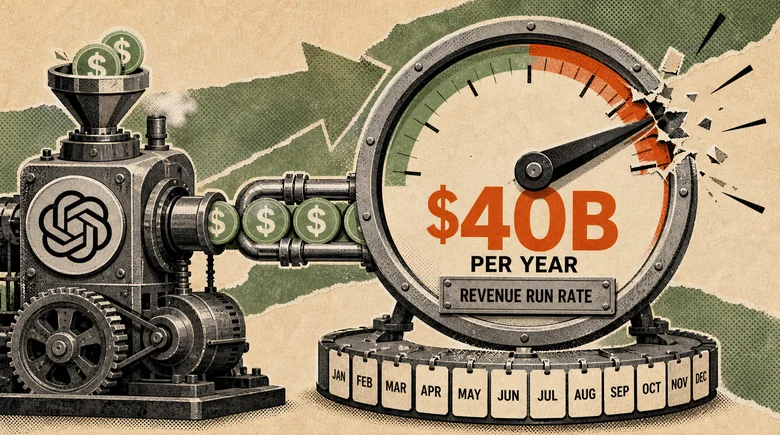
OpenAI is now on pace to make more than $40 billion a year, going by how the business is selling right now.
That is about double where it stood at the end of 2025.
Bloomberg's Natasha Mascarenhas and Rachel Metz reported the number on 13 August. It came from people who know the figures and asked not to be named. OpenAI declined to comment.
The news landed on an awkward day. A few hours earlier, OpenAI had replaced its head of sales for the second time in under a year.
Greg Brockman Told Staff July Grew More Than 20%
A run rate is a simple sum. You take a recent stretch of sales and multiply it out to a full year. One strong month can lift the whole figure.
July was that month. Greg Brockman, OpenAI's co-founder and president, told staff in an internal note that the run rate grew more than 20% in July alone, measured against June.
Multiply one very good month by twelve and you get a very big number. That is how $40 billion was built.
The sales behind it are real. Bloomberg says demand for OpenAI's agents has risen sharply in recent weeks, led by Codex for coding and ChatGPT Work for everyday office jobs. Sarah Friar, the chief financial officer, had said OpenAI ended last year above $20 billion on the same measure.
Just do not read $40 billion as money OpenAI has already made. It has not made it. That is what the company would earn if July happened eleven more times.
Brockman is also the person who shared it. He put the figure in a staff note about a new hire, and it reached Bloomberg the same day. A company getting ready to sell shares to the public chooses its numbers with care.
OpenAI is replacing chief revenue officer Denise Dresser with Wiz president Dali Rajic, just 8 months after Dresser joined.
— Stephanie Palazzolo (@steph_palazzolo) August 13, 2026
Meanwhile, Greg Brockman told staff that total ARR grew 20%+ and enterprise ARR grew 32% in July.
Business Customers Grew 32% in a Single Month
The better number sits further down. OpenAI's sales to business customers grew 32% in July over June, mostly from large companies. DealBook broke it, and Axios confirmed it the same day.
Business sales are growing faster than the company as a whole. That gap explains most of what OpenAI has done this year.
Axios also reports that OpenAI expects business customers to bring in half of all its money by December. ChatGPT had more than 900 million weekly users in March, so OpenAI is still a consumer product first. Reaching an even split in four months would be quick work.
$40 Billion and Anthropic's $47 Billion Do Not Match
Anthropic said in May that its own run rate had passed $47 billion. The two numbers look easy to compare, but they are built differently.
No rule says how a run rate has to be worked out. A company can multiply out its last month, its last quarter or even its best week. Bloomberg says in its own report that the two firms may not measure it the same way.
Anthropic's figure is also three months old, while OpenAI's comes from its fastest month of the year. Anthropic then raised money in late May at a value close to $1 trillion, so investors have already priced that $47 billion. Nobody has done the same for OpenAI's $40 billion.
Neither company has published accounts checked by an outside auditor. Until one does, both figures are numbers the firms picked for themselves.
Ramp Had Anthropic Ahead 34.4% to 32.3% in April
The $40 billion matters most as an answer to Anthropic.
Ramp tracks company card and invoice spending at more than 50,000 US businesses. Its April figures put Anthropic on 34.4% of business AI use, up 3.8 points in a month. OpenAI slipped 2.9 points to 32.3%. Claude Code drove most of that, as Anthropic moved out of engineering teams and into finance and legal work.
OpenAI saw it coming. In March, Fidji Simo told staff the gap with Anthropic was a code red, and that the company could not miss the moment because it was distracted by side quests. Sora, the Atlas browser and the shopping features were all cut or shrunk in the months that followed.
Codex is what OpenAI got out of that. Weekly Codex users passed 2 million by March, four times the January count, once scattered coding projects were folded into one product.
July's 32% jump in business sales is the first real sign the clean-up worked. Ramp's next figures will show whether OpenAI has taken the lead back.
Simo, Lightcap and Dresser All Left Inside Five Weeks
All this growth happened while OpenAI's sales leadership emptied out.
Fidji Simo, who ran the apps side, stepped down on 10 July over health issues. Brad Lightcap, the former chief operating officer, announced his exit on 11 August. Denise Dresser, hired from Slack as head of sales in December, announced hers on 13 August.
"I wanted to let you know that I made the difficult decision to leave OpenAI in the coming weeks to pursue other opportunities."
Denise Dresser, on LinkedIn
Dresser had been doing two jobs at once. She covered for Lightcap after he moved out of the COO role, and for Simo while she was on medical leave. She was also OpenAI's public face for business customers, and she interviewed Sam Altman on stage at the company's own event on the subject.
Axios reports that Brockman is taking on more of the day to day running of OpenAI and building his own group of leaders. He has promoted Joy Jiao, at the company since 2022, to head of life sciences.
Senior people leaving usually points to a business in trouble. Here the sales figures climbed through the same five weeks. That looks less like trouble and more like an argument over who runs growth, and Brockman has come out on top.
OpenAI Picked a Cloud Security Boss to Run Sales
Dresser's replacement is Dali Rajic. He was president and chief operating officer of Wiz, the cloud security company Alphabet bought.
OpenAI can hire plenty of people who know how to sell software. Picking someone out of security points at where its deals keep dying.
Big AI deals rarely fall over during the trial. They fall over later, when a bank or a hospital sends in its security team and asks where the data goes and who gets to see it. Rajic spent years selling to those teams. Hiring him is a bet that the hold-up is paperwork, not the product.
It fits the rest of OpenAI's year. The company added Lockdown Mode to ChatGPT in February and shipped a security model in July. Rajic is the sales half of the same push.
Price Cuts Sit Inside the $40 Billion
Bloomberg also reports that OpenAI has cut the price of some models. It is chasing customers who watch their budgets, against Anthropic and a long list of Chinese rivals.
That changes how you should read the growth. Sales going up while prices come down means customers are buying far more than the headline suggests. Good for growth, hard on profit.
Developers feel this part first. Token prices keep falling, Chinese open-weight models keep undercutting everyone, and OpenAI has chosen to hold its share of coding work even if that means charging less for it.
Profit is the number OpenAI will have to publish once it sells shares to the public. Ads were meant to help there. Bloomberg still calls its ad business new and small, seven months after Sponsored Recommendations turned up in ChatGPT beside the $8 ChatGPT Go plan. So most of that $40 billion is still subscriptions, API use and coding.
Anthropic Lists This Autumn and OpenAI Waits
Both companies have filed IPO paperwork in private. Anthropic filed first and could go public as soon as this autumn, ahead of OpenAI, which filed in June. OpenAI closed its last private funding round on 31 March at an $852 billion valuation, raising $122 billion.
Whichever one lists first has to publish real accounts, signed off by auditors. That will be the first time anyone outside these companies sees what an AI lab actually earns and spends. Every private figure quoted before then gets held up against it afterwards.
So the timing here looks deliberate. OpenAI has put its best number in front of investors just as Anthropic gets ready to show audited ones.