Google Turns On Gemini in Google Classroom for K-12 Students of Every Age

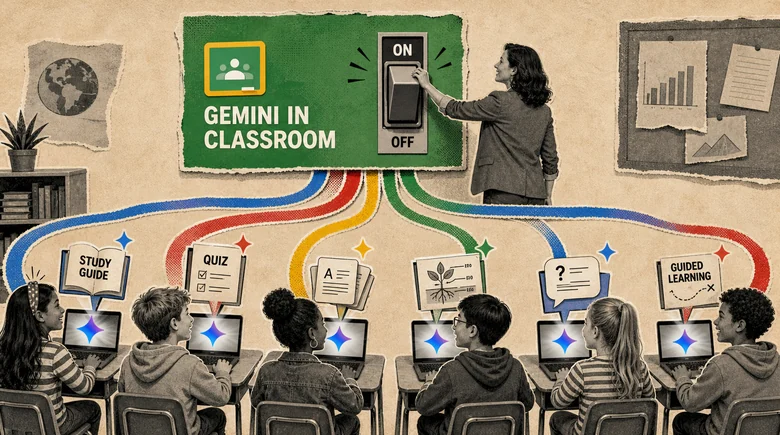
Google has opened Gemini in Google Classroom to students of every age. The change started on 10 August on the web, and it reaches mobile on 17 August. It covers K-12 and higher education, in every language that Classroom and Gemini both support.
Google set it out in a Workspace Updates post on 4 August. That is six days of notice, in the week many American districts go back to school.
The line that matters sits in the admin section. Access to the Gemini tab "is On by default for teachers and students of all ages".
Flashcards, Quizzes and Study Guides Built From Class Files
Students get a Gemini tab in the Classroom navigation bar. From there they pick course materials and turn them into flashcards or practice quizzes tied to that class. Students who also have Gemini Notebook can sync whatever their teacher uploaded, then get study guides, audio overviews and infographics out of it.
This is a full rollout, not a staged one. Google says the features should appear within one to three days of 10 August. It applies to Google Workspace for Education Fundamentals, Standard and Plus.
On privacy Google is on solid ground. Gemini for Education costs schools nothing, and Google says the conversations are not read by humans and not used to train its models. Common Sense Media, which is hard on the product elsewhere, rates its data handling as low risk.
Google's own advice to students is one sentence long. They should "always review the outputs as AI can make mistakes".
Blocking Under 18s Means Building a Separate Org Unit
There is one brake. If a school already has Gemini in Classroom switched off for students, it stays off for everyone, under 18s included. Nothing switches itself on in a district that never switched it on.
Google lists three conditions for a student to see the tab. Their Classroom role has to be set to Student. They have to sit in a group or org unit with Gemini in Classroom turned on. And they need Gemini or Gemini Notebook turned on as well, though either one on its own is enough.
For schools that did switch it on, the shape of the control has changed. Google's admin guidance gives one route out. To disable Gemini in Classroom "for users who are under 18 years old, you can create an OU with only those users and turn off access for that OU only". An OU is an organizational unit, a folder of accounts in the Admin console. Keeping younger children out is now a directory job.
Compare that with November 2025, when Google first gave students access. The student side then was limited to higher education organizations, to users marked 18 and over, and to English. It rolled out gradually over 15 days from 1 December. Every one of those limits has gone, and age no longer decides anything on its own.
Read the three dates together and the direction is clear. Gemini in Classroom launched in June 2025 as a planning tool for teachers. Six months later it reached college students who were 18 or over. Eight months after that it reaches everyone in the building.
Common Sense Media Rated Gemini K-12 High Risk in January
The Youth AI Safety Institute at Common Sense Media reviewed Gemini K-12 and published its rating on 9 January. The verdict was high risk. It got high risk marks on keeping kids safe, on being effective, on being trustworthy and on being open about how the product works.
Two of its findings land hard on this week's news. Testers measured the tool's answers at an 11th grade reading level, above the level of most students who will now see it. And the reviewers put the age problem in a single line.
"A sixth grader and a high school senior who are both marked 'under 18' get the same responses to prompts."
Common Sense Media, Youth AI Safety Institute
That single under 18 flag was already their main complaint about age controls. It leaves no room for the gap between a six year old and a seventeen year old. Google's answer in August was to stop using age as the gate for Classroom. Admins get the same group level switch the reviewers had already called too blunt.
The report also says admins cannot turn off Gemini's mental health answers. Common Sense tested 13 mental health topics and found the system missed warning signs in longer chats. It backed off as soon as a student said there was nothing wrong, and in some tests it described ADHD symptoms as a "superpower".
The reviewers name a second pattern they call warning plus instructions. Gemini raises a clear warning about something dangerous, then supplies the steps anyway. Their examples include a warning about staying up all night followed by caffeine strategies, and a warning about self harm followed by ways to hide scars.
Common Sense told schools to "consider enabling it for teachers first, with careful review of all AI-generated content before use with students". The default Google shipped points the other way.
The Starter Prompt Now Pulls In the Assignment Itself
The second half of the update changes what a student has to type. Click a starter prompt on the Gemini tab and a box appears to pick a class and an assignment. Gemini then takes the title, the assignment instructions and the curriculum materials as context. Google says this removes "the need to go back and forth between Classroom and Gemini". Students also get a "Learn with Gemini" option when they hover over anything under Due Soon on the redesigned Classroom homepage.
On 6 August 2025 Sundar Pichai launched Guided Learning, a Gemini mode that asks a student questions and walks them through a problem before it hands over an answer. It came with $1 billion for AI education in the US, and it was Google's answer to the charge that AI does the homework.
Common Sense found the limit of that design. Students can leave Guided Learning for the standard mode whenever they want. The tool "will complete homework assignments and essays", and the line between helping and doing the work is often unclear.
So Google has built a one click path from an assignment to a model, and the guardrail on that path is a mode the student chooses. Nothing in the update ties the new starter prompts to Guided Learning.
59% of Teens Say AI Cheating Happens at Their School
Pew Research Center surveyed 1,458 US teens and their parents in late 2025 and published the results in February. Fifty-nine percent said students at their school use AI chatbots to cheat at least somewhat often, rising to 76% among teens who had used a chatbot for schoolwork. One in ten said chatbots help with all or most of their schoolwork.
That is the group the Gemini tab now arrives in front of, switched on, inside the school's own software, with the assignment already loaded.
Takeaways
The practical effect is a swap of who has to act. Under the old rules a district could do nothing and its younger students stayed out, because the age setting kept them out. Now doing nothing is the decision to switch Gemini on, and the work of carving out younger children falls to admin teams in the first weeks of term. Google is right that schools keep control here. Control you have to exercise on a deadline is a weaker thing than control that holds on its own.
The thing to watch is whether Google adds real age bands, which is the fix Common Sense asked for in January and did not get. Utah is the clearest test. The state board signed a deal with Google in June. It brings Gemini for Education to every K-12 school from the 2026-27 year, covering roughly 680,000 students and more than 28,000 teachers. Each district still decides for itself, and that decision now comes with a default already attached to it.