Claude Shared Chats Are Off Google. The Artifacts Are Still There.
Google stopped returning shared Claude conversations on Monday, and the story was written up as fixed. We ran both searches again on Wednesday morning. The chats are gone. The published Artifacts are still listed, with Google showing what is inside each document.

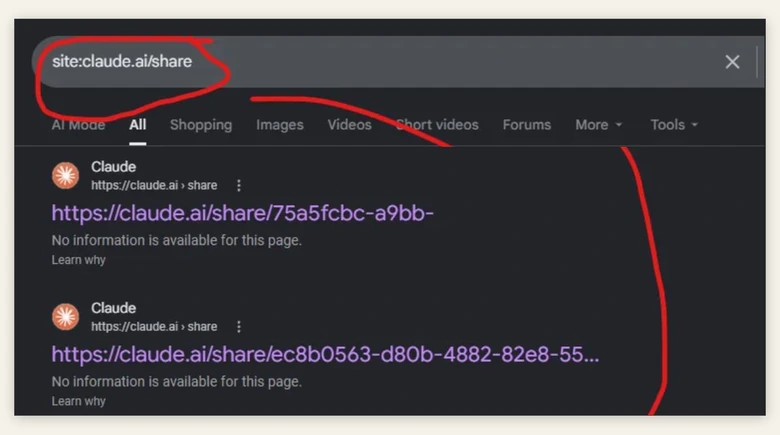
Last Saturday somebody in the main Claude subreddit posted a Google search: site:claude.ai/share. That search asks Google to list every page it knows about on one specific part of a website. It came back with page after page of other people's conversations with Claude.
Nothing was hacked. No database leaked. The search operator that did this has worked on every website for twenty years, and it just was not supposed to find anything here.
The thread reached 8,000 upvotes. A day later somebody ran the same search on Artifacts, the documents and apps you can build inside Claude. By Monday the conversations had stopped showing up in Google, and the story was written up as dealt with.
So what is still on Google?
We ran both searches again on Wednesday morning, four days after the first thread.
The conversations really are gone. site:claude.ai/share now returns "did not match any documents".
The Artifacts are not gone.
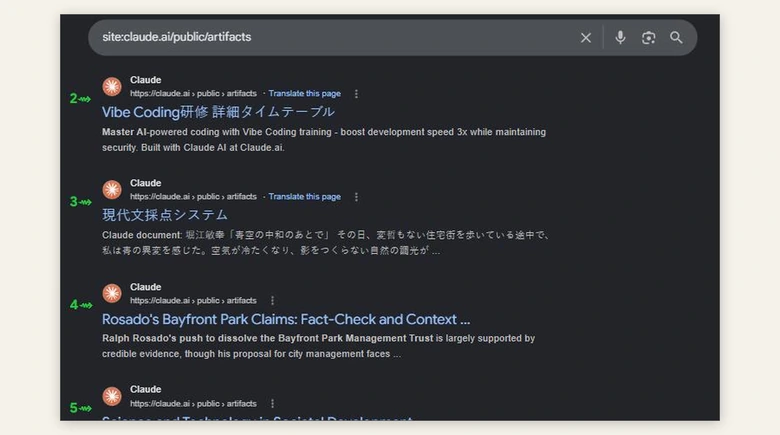
That search still returns roughly ten pages of results. Google is showing each document's title and a description of its contents, which is how you can tell from the results page alone that one of them is a fact-check on a Miami parks decision, one is a Japanese literature grading system, and one is an accounting case study from Peru. Further down there are business plans and a cloud architecture diagram.
Two Google searches run from an ordinary browser on the morning of 29 July 2026. site:claude.ai/share returned no documents. site:claude.ai/public/artifacts returned results paginated to page 10. We also fetched claude.ai/robots.txt the same morning: it still lists Disallow: /share/* and still contains no line at all for /public/artifacts. We did not open anybody's conversation or document.
Why did one get cleaned up and not the other?
Because they were never treated the same way.
Anthropic uses a file called robots.txt, which tells search engines which parts of a website to stay out of. Shared conversations have been on that list for a long time. Published Artifacts have never been on it, and when we checked on Wednesday they still were not.
That gap explains the odd shape of the original leak. Because the conversations were blocked, Google knew their addresses but had never been allowed to open them, so those results appeared as bare links with "No information is available for this page" written underneath. You had to click one to learn anything.
The Artifacts had no such block, so Google read them properly and kept the titles and the summaries. The half that was protected leaked less. The half nobody protected is the half still sitting in the search results with its contents on display.
Were private chats leaked?
No.
Claude conversations are private unless you press Share. That button takes a snapshot of the conversation and turns it into a web page with its own link. It exposes that one conversation, and not your account, your other chats, or anything you did not share.
So no database was breached and nothing private was taken. What happened is that a lot of people found out the Share button does more than they thought it did.
Reporters who went through the results last weekend found the sort of thing people paste into a chatbot without thinking twice. Futurism reported a patient's medical report, clinical trial results with patient names in them, a document listing the names and phone numbers of primary school children, and company files marked internal.
Anthropic's position is that this is simply how a public link works. Here is the statement it gave TechCrunch:
"These shareable links are not guessable or discoverable unless people choose to share them themselves. When someone shares a conversation, they are making that content publicly accessible, and like other public web content, it may be archived by third-party services."
Amie Rotherham, Anthropic
That is true, and it is still worth arguing with.
When you share a Claude chat, the box tells you the link will work for "anyone with the link". Google Docs shows you almost exactly the same wording when you turn on link sharing. So does YouTube when you mark a video as unlisted. In both of those cases the file stays out of search results, so people have learned to read that phrase as "the people I send this to". With Claude, it turned out to mean the open web.
Also: Claude Opus 5 tops the benchmarks while early testers call it hard to love
How can you check yours?
It takes about two minutes, and given what is still in Google, step three is the one that matters most this week.
- In Claude, open Settings → Privacy → Shared Chats and tap Manage. Every link you have ever created is listed there, including one you might have made a year ago and forgotten.
- Turn off sharing on anything you would not want on a public page. Do not ask yourself whether it feels sensitive. Ask whether you would mind it having its own web address, because it already has one.
- Check your Artifacts separately. Turning off sharing on a conversation does not unpublish an Artifact you built inside it, and the Artifacts are the ones still appearing in Google. Open the Artifact and turn off sharing there as well.
- If a chat contained an API key, a password or a client's data, go and change that credential. Turning off the link is not enough on its own.
Does turning off the link fix it?
For anyone who finds the link from now on, yes. For anyone who already opened it, no.
Removing a page from Google does nothing to the page itself, and turning off a link does nothing about copies other people already saved. Anthropic's own statement says the content may be archived by third parties, and that is exactly what happened to OpenAI last year. When it switched off discoverable ChatGPT chats in August 2025, many had already been copied into the Internet Archive, where they are still readable today.
Which is why the Artifacts still being listed matters more than it looks. Every day they stay in the results is another day somebody can find one, open it, and keep a copy that no amount of unsharing will reach.
Google pulled Bard transcripts out of search in 2023. OpenAI removed its discoverable-chats checkbox in 2025. Anthropic had a smaller version of this in September 2025. Three companies, three years, the same misunderstanding each time, and this one is not finished yet. Until the Share button says what it really does, treat it as a Publish button: if you create a link, assume the page is public, because it is.
robots.txt, both of which are public. The document titles in our screenshot are the ones Google itself is publishing.