OpenAI Is Giving 100,000 Researchers Free ChatGPT. Here's Who Qualifies.
OpenAI will give 100,000 academic researchers free access to its top models by 2027, starting with 10,000 this summer. Approved applicants get a five-seat ChatGPT workspace with Pro-level limits for 12 months. Only faculty and postdocs with a recent preprint can apply, and the offer covers ChatGPT, not the API.

OpenAI will give 100,000 academic researchers free access to its most capable models through a new program called ChatGPT for Academic Researchers, announced on Wednesday. The first 10,000 seats open this summer, and access is already running at the Institute for Advanced Study in Princeton and at France's École normale supérieure.
The offer is aimed at scientists, mathematicians, and engineers, and it is worth real money. An approved researcher gets a dedicated workspace with the same usage limits as ChatGPT Pro, the subscription that sells for $100 or $200 a month, free for 12 months, with room for four invited colleagues on top.
We're giving scientists, mathematicians, and engineers free access to our frontier models—starting with 10,000 researchers and expanding to 100,000 through 2027.
— OpenAI (@OpenAI) July 29, 2026
ChatGPT for Academic Researchers is built to accelerate discovery across disciplines.
Here is how OpenAI describes it in the announcement:
"We're introducing ChatGPT for Academic Researchers, a program that will give 100,000 researchers at selected academic institutions free access to our frontier models."
What's in the free workspace?
The GPT-5.6 family of models at launch, including GPT-5.6 Sol Pro, the heavy reasoning tier that OpenAI otherwise reserves for Pro subscribers. Participants also get expanded deep research, larger context windows, and access to Codex, OpenAI's coding agent, and ChatGPT Work, its tool for longer multi-step projects.
On top of the models sit more than 75 life science skills covering genetics, genomics, sequencing, protein modeling, and drug discovery, plus connectors to scientific literature, public genomic databases, computational notebooks, and reference managers like Zotero.
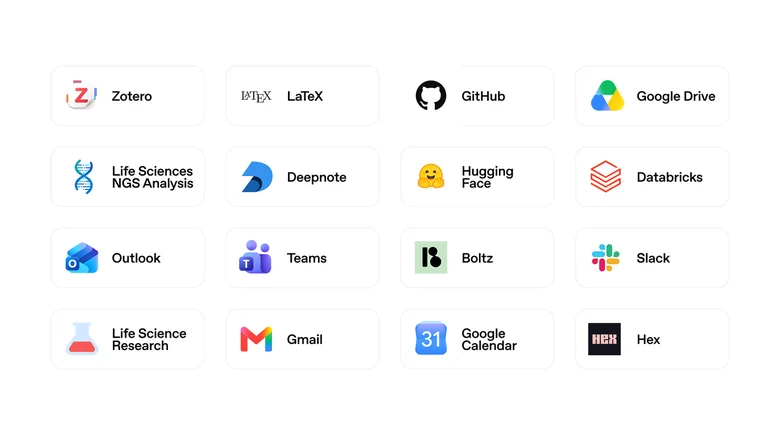
The workspace carries business-grade privacy protections, and OpenAI says the data inside it isn't used to train its models by default.
OpenAI's own benchmark numbers explain why it leads with math and science. The company says GPT-5.6 Sol scores 83% on FrontierMath Tier 4, a test of research-level mathematics, up from 72.5% for GPT-5.5. Those are OpenAI's figures, not independent ones. The same announcement claims a growing number of math papers now credit ChatGPT by name.
Who can apply?
Research faculty and postdocs. That's the whole list.
The program FAQ sets four conditions: you must currently hold a research faculty or postdoctoral position at an eligible institution in a supported country, verify that affiliation through SheerID, a third-party identity checker, and submit a paper posted to arXiv, bioRxiv, or ChemRxiv within the last three years that lists you as an author. You also describe what you plan to use ChatGPT for. Meeting all of that lets you apply. It doesn't guarantee approval.
If you're a PhD student, you can't apply yourself. An approved researcher can invite four collaborators from the same institution, and OpenAI's rules only require invitees to verify their affiliation, not to hold a faculty post. So a seat on a supervisor's workspace looks like the way in for students, but OpenAI hasn't spelled that out anywhere we can find.
One thing we checked ourselves: OpenAI says eligible institutions "must be recognized, degree-granting colleges or universities with a high level of research activity," and links a list of them. That eligibility list sits behind a ChatGPT login. When we opened it on Thursday morning we got a sign-in page, not a list, so you will need an account just to find out whether your university is on it.
What's the fine print?
The FAQ is short and worth reading in full before you apply. The details that matter:
- The checkout total is $0, but the workspace owner still has to enter a payment card to complete it.
- The offer doesn't renew by itself. OpenAI says it will share continuation options before the 12 months end, and if you take none of them the workspace is deactivated after a grace period. You won't be quietly charged, which is more than most free trials manage.
- It covers ChatGPT only. There are no API credits in the program, so anything you have built against OpenAI's API still costs what it cost yesterday.
- One verified email can belong to one researcher workspace at a time, and collaborators must come from the applicant's own institution.
- If your university already runs ChatGPT Edu, you still apply the same way, but your access gets set up inside the institution's existing workspace.
Why is OpenAI doing this?
OpenAI frames the program as part of more than $250 million it has committed to outside science through 2027, alongside its $50 million NextGenAI fund for research institutions and its work on the US Department of Energy's Genesis Mission.
Here is our math on that commitment. At ChatGPT Pro's list price of $100 to $200 a month, 100,000 accounts over 12 months come to $120 million to $240 million of access at sticker price. In other words, most of that headline number can be paid in seats of OpenAI's own product, which costs the company far less to give than cash grants would.
There is also a race on for scientists. Anthropic has run an AI for Science program since May 2025 that gives selected researchers up to $20,000 in API credits, weighted toward biology and life sciences. OpenAI's counter is bigger and simpler: full product access instead of credits, for a hundred times more people.
Our read: this is a land grab, and a well-designed one. OpenAI says roughly 1.3 million people already use ChatGPT for advanced science and math every week, and the announcement is open that participants' feedback will show the company "where our models are useful, where they fall short." OpenAI gets 100,000 experts stress-testing its models on the hardest problems available, plus the acknowledgment lines in the papers that follow. Researchers get a genuinely expensive tool for nothing. Both sides profit, and only one of them is setting the default tools of every lab for the next decade.
Also: Claude Opus 5 tops the benchmarks while early testers call it hard to love
Applications are open now on OpenAI's program page, starting with 10,000 researchers this summer and growing to 100,000 through 2027. The free period is 12 months, a workspace holds five people, and every invited collaborator counts against the total. If you qualify, apply early. The queue only gets longer from here.