Apple Trained Its Own AI Model for China, 22 Months After Promising Apple Intelligence There

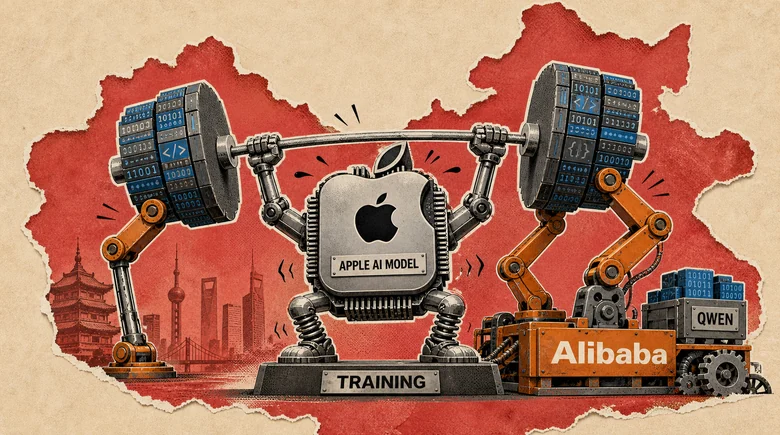
Apple has trained a large language model built only for the China market. Three people familiar with the work described it to Reuters, which published the story on 14 August. Alibaba helped train the model. The people asked not to be named because the work is sensitive and not public.
That is a change of plan. Until now, Apple was going to borrow. Chinese iPhones were set to run Apple Intelligence on models from Alibaba and Baidu, because Anthropic's Claude and OpenAI's ChatGPT are not available in the country. Apple and Alibaba did not respond to requests for comment.
Getting permission is the harder half of this. Training a model is ordinary work for Apple, which has shipped its own models since 2024. No foreign company has been cleared to run a proprietary AI model inside China before.
Apple's Own Model Will Run Next to Qwen and Baidu
Apple keeps both Chinese partners and adds its own model on top.
Alibaba's Qwen handles language in the Chinese build of Apple Intelligence, and Baidu handles visual and AI search. Apple's own model joins them as a third piece. Two tracks, one running on Apple's technology and one on approved Chinese technology, is an arrangement no other foreign firm operates in China.
The reason to want it is control. A model Apple trains is a model Apple can hold steady. Partner models get updated, repriced or withdrawn, and Apple has no vote in any of that. Owning one track means the AI experience on a Chinese iPhone does not move every time a supplier ships a new version.
What the model actually does is still open. The phrase carrying the most weight in the reporting is that Alibaba gave "support", and that covers three very different arrangements. Alibaba may have rented Apple the compute. It may have supplied Chinese-language training data, which is the part Apple is weakest on. Apple may also have started from Qwen weights and carried on from there. The last of those would make Apple's model a Qwen derivative, a much smaller step than it sounds. Nobody outside the two companies knows which it is.
China Approved Apple Intelligence on 15 July
Apple began promising Apple Intelligence in China when the iPhone 16 launched in September 2024. Every mention carried the same footnote: subject to regulatory approval. Clearing it took nearly two years.
On 15 July 2026, the Cyberspace Administration of China registered Apple's generative AI service on a list of seven on-device services for phones. Apple's entry sits under Apple Technology Development (Shanghai) Co., Ltd. The other six went to handset makers already selling in China.
The registration set no launch date, which is why the timing still matters. Under China's rules a public generative AI service has to be filed before it ships, and foreign firms have in practice needed a local partner to do it. Apple's filing describes an on-device service.
Alibaba confirmed its part the same day. A spokesperson told CNBC what the deal covers.
"Qwen will be integrated into Apple Intelligence experiences within iOS, iPadOS, macOS, and visionOS for users in China."
Alibaba spokesperson, to CNBC
Alibaba's US-listed shares rose about 4% in premarket trading that day. The features themselves are expected on Chinese iPhones in the coming months, after an iOS update.
Apple Rents Its AI at Home and Owns It in China
Compare that with what Apple did in its own market.
In January 2026, Apple and Google confirmed in a joint statement that Gemini would power the rebuilt Siri. Apple said Gemini "provides the most capable foundation" for its AI. Bloomberg had reported the price at roughly $1 billion a year, for a model of 1.2 trillion parameters.
So in the market where Apple can choose any supplier it likes, it paid a rival. In the market with the tightest rules and the fewest options, it built its own. The usual telling of Apple's AI story is a company that fell behind and had to rent. China turns that around.
Partner risk explains a lot of it. On 7 July, Chinese commerce officials met ByteDance, Alibaba and Z AI to discuss limits on foreign use of their strongest models, with Qwen named in the talks. Nothing there points at Apple. It does describe a partner whose model can be repriced or restricted by people Apple does not answer to, five weeks before Apple's own model surfaced.
Apple's Qwen Guide for Macs Lasted One Day
Six days before the news broke, Apple published a Chinese-language support page for Macs. It explained how someone in mainland China could connect Qwen to Siri and to Writing Tools. Siri could hand Qwen requests that needed a closer reading of photos or documents. One example had a user ask Siri to get Qwen to write a poem.
The extension needed macOS 26.6 or later and the user's own Qwen account. Alibaba was barred from training on anything users sent through it. Apple published nothing equivalent for the iPhone or iPad, even though Qwen is meant to cover all four of its operating systems in China.
The page went up on 8 August and was gone by 9 August. Apple gave no reason.
Apple Support told AppleInsider that it had heard nothing about a launch. This is the translated statement.
"We are notified in advance whenever a feature or new project is launched. We have not received any such notification, and the feature integrating Apple Intelligence with Qianwen [aka Qwen] has not yet been released in mainland China."
Apple Support, via AppleInsider
Liu Dingding, a veteran tech analyst, gave the Global Times another reading on 9 August. The takedown "might signal pending tweaks to technical details amid ongoing regulatory progress", he said.
Read that page again now. A guide describing only a Qwen extension would be an incomplete picture of what Apple is shipping. Apple has explained nothing, so this is a guess. The timing fits, and it was the second Apple AI feature to appear early in China this year. Apple Intelligence reached some Chinese users by mistake in March 2026 before it had approval, and Apple pulled it.
Apple Grew 24.4% in China Without Any AI Features
The standard reading of this move is that Apple is chasing Huawei. Over the last few years that holds up. In the most recent quarter it does not.
IDC put China's smartphone market down 4.3% in the second quarter of 2026, at roughly 66 million units, the fifth quarterly fall in a row. Huawei led on 22.6% share, up from 18.1% a year earlier. Apple came second on 18.1%, up from 13.9%.
Apple's shipments grew 24.4% year over year, the strongest growth of any major brand in the market. Its Greater China revenue came in at $18.82 billion for the June quarter, up 22% from $15.37 billion. IDC credited stable pricing and heavy promotions, plus buyers moving early ahead of expected iPhone 17 price rises.
Apple grew that fast with no Apple Intelligence in China at all. That weakens the idea that missing AI features were the main drag on sales.
Takeaways
The new model raises the bar for Apple in China. It is shipping AI into a market where it is already winning, which is a harder place to prove a feature earned its keep. Owning one of the two tracks is the part that lasts. It gives Apple something in China that no other foreign company has, and something no supplier can reprice or withdraw.
Three things will show how real this is. The first is the CAC register, where Apple's own model has to be filed before it can ship. The name on that filing will say who owns the track. The second is the Mac guide, and whether an iPhone version turns up alongside it when it comes back. The third is what Apple says the model actually is, because trained with Alibaba's support still covers everything from rented compute to a Qwen derivative.