70% of People Fear AI Will Destroy Jobs in Developed Countries


Pew Research Center asked people in 37 countries what AI will do to jobs where they live. In 34 of those 37, more people said it will cut jobs than said it will create them.
The report came out on 17 September and covers 42,151 people, which makes it the widest look yet at what the public thinks about AI and work. The short version is that the public is a great deal more worried than the industry is.
People in Developed Countries Fear More About AI Job Loss
Across 18 high-income countries, a median of 55% expect AI to reduce jobs. Across 18 middle-income countries, it is 36%.
Pew surveyed 42,151 people in 36 countries between 8 February and 13 May, and ran two separate surveys of US adults. The full report is published on the Pew site.
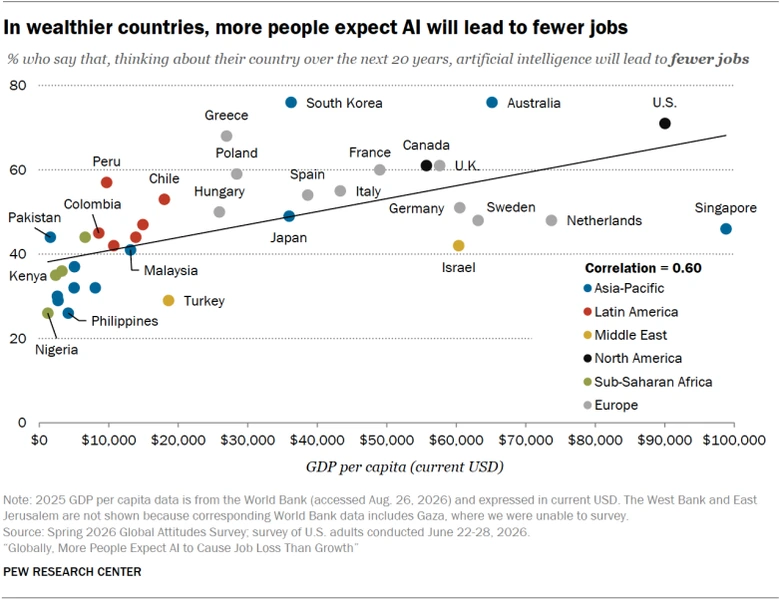
The countries where people most expect AI to destroy jobs:
- Australia and South Korea, both at 76%
- United States, 71%
- Greece, 68%
- Canada and the UK, both at 61%
The US number is the one with history behind it. Pew has asked Americans this question before, and 71% is up 7 points in two years.
In middle-income countries, a lot of people have simply not made their minds up. A median of 34% there say they do not know what AI will do to jobs, against 22% in high-income countries. India is a clear example, where 29% expect fewer jobs and 35% say they are not sure.
The likeliest reason is exposure. Half of adults in high-income countries have heard or read a lot about AI, against 27% in middle-income countries. In richer economies AI is moving into software, customer support, data work and marketing, so people are watching it do parts of their own job. That makes job loss feel less like a forecast and more like something already underway.
Education pulls in the same direction. In many countries, people with more schooling are more worried, and they are also the people best placed to picture exactly which parts of their work a model could take.
Wealth Gap Will Worsen Because of AI
A median of 35% in high-income countries say AI will widen the gap between rich and poor, against 22% in middle-income countries.
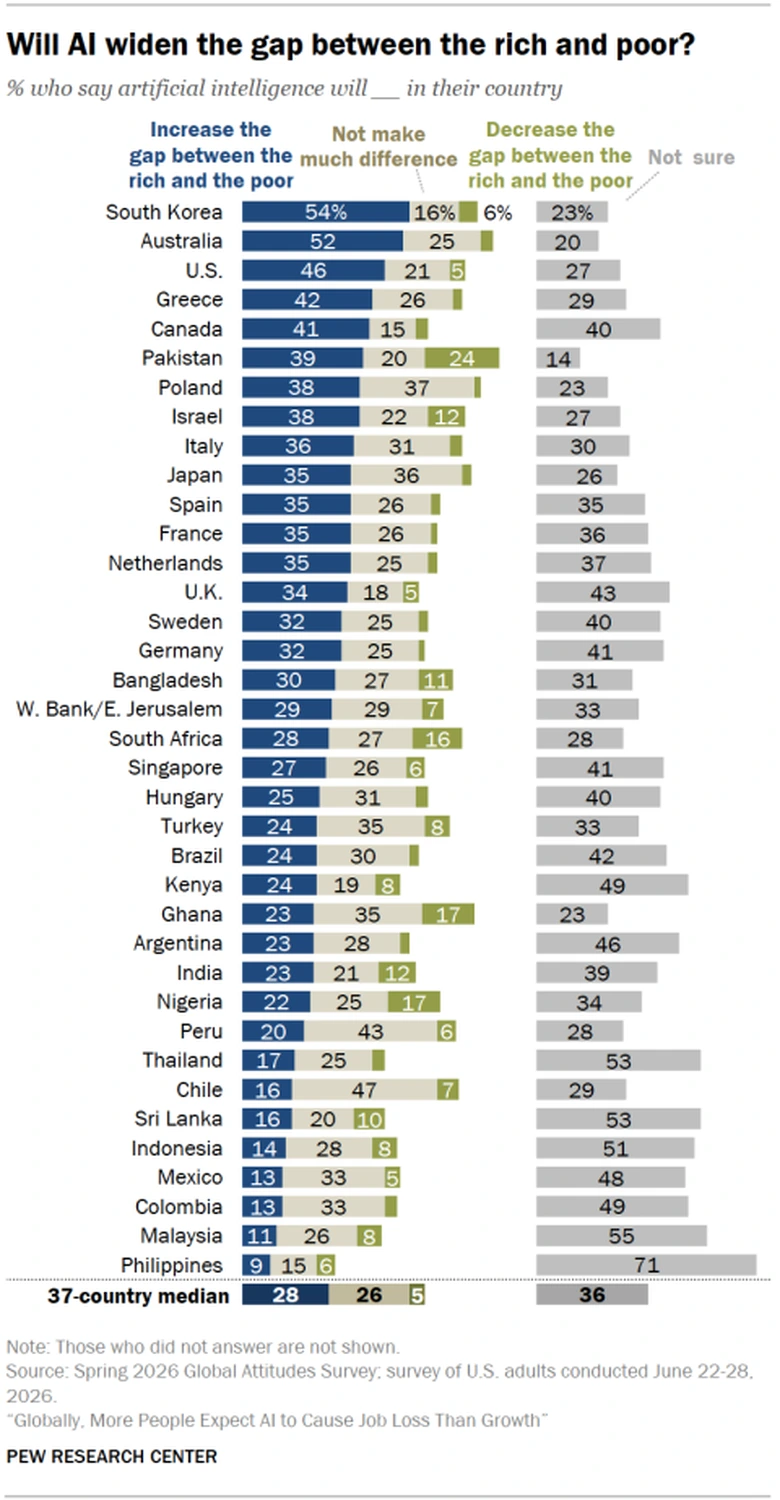
South Korea sits at the top at 54%, then Australia at 52%, the US at 46%, Greece at 42% and Canada at 41%. Those are mostly the same countries that lead on job loss, which makes sense, because the two worries are the same worry.
If AI does the work, whoever owns the system keeps more of what the work earns. Mass unemployment is not required for that to bite. Even if AI creates as many jobs as it removes, the gains can still land unevenly. They go to the people who own the companies, and to the people with the skills to work alongside the tools.
The Philippines shows how differently this reads elsewhere. Only 9% there say AI will increase the gap, and 71% say they are not sure.
What almost nobody believes is the optimistic case. There is no country where more than a quarter of people think AI will narrow the gap, and in 29 of the 37, that share is in single digits.
Takeaways
The number worth sitting with is that 7-point jump in the US. Two years ago plenty of Americans had barely touched these tools. Now 71% expect them to cost jobs.
The survey cannot tell us whether they are right. Every large technology shift so far has wiped out particular jobs and created more of them somewhere else, which is the argument the industry reaches for every time. The printing press cost scribes their work and built publishing around the wreckage. But that argument only reassures people who expect to end up on the right side of it, and in rich countries most people clearly do not.
So governments are going to be writing AI policy in front of populations that already expect to lose. That is the starting position, whether or not the fear turns out to be justified.